

-
SOLUTIONSIn recent years, “Hegerls" HD shuttle storage system have improved, upgraded, more intelligent, flexible, and more systematic, which can meet the different needs of customers in various industries.
 SERVICE
 -
-
R & DObtained more than ten national patents for automated logistics warehousing equipment such as shuttle cars, stackers, and mobile shelves, awarded SGS, BV, and TUV international product quality inspection agency certificates, as well as the "Quality, Environment, Health" ISO three major system certification certificates.
SERVICE
-
PROJECTSAfter Haigelis entered the international market in 2011, it exported supermarket equipment, warehousing equipment, and related supporting products to countries and regions such as North America, South America, Europe, Southeast Asia, and Africa. In recent years, the company has increased its efforts in the research and development of automated warehousing equipment.
SERVICE
-
BlogProfessional articles, guides, and insights on warehouse racking and automated storage systems.
SERVICE
-
HEGERLSIt's developed over 20 years, our company has become a one-stop integrated service provider of warehousing and logistics, integrating warehousing and logistics project design...
SERVICE

APPLICATION
Automated Storage Systems: The Future of High-Density Smart Warehousing
Classification:
Industry Info
Release time:
2026-05-27
Introduction: Why Automated Storage Is Transforming Modern Warehousing
Modern supply chains require warehouses to become faster, denser, smarter, and more accurate. Traditional storage methods often struggle with:
- Increasing SKU complexity
- Rising labor costs
- Limited warehouse space
- Higher order fulfillment expectations
- Inventory inaccuracies
- Energy consumption pressures
This is why automated storage systems and ASRS (Automated Storage and Retrieval Systems) are becoming essential technologies in modern logistics.
According to industry research from LogisticsIQ and MHI, the global warehouse automation market is expected to exceed $50 billion by 2030, driven by e-commerce, manufacturing automation, and smart logistics demand.
An automated storage and retrieval system (ASRS) uses software, robotics, shuttles, cranes, and intelligent controls to automatically store and retrieve inventory with minimal human intervention.
HEGERLS provides advanced automated storage solutions including:
- Four-way shuttle systems
- ASRS warehouse systems
- Integrated racking systems
- Automated bin storage systems
- CC-WMS intelligent warehouse software
These solutions help companies improve throughput, maximize storage density, and reduce operational costs.

What Is ASRS?
ASRS Meaning
ASRS stands for:
Automated Storage and Retrieval System
It is a warehouse automation solution designed to automatically place and retrieve goods from storage locations using intelligent equipment and software.
ASRS systems typically include:
- Storage racks
- Automated cranes or shuttles
- Conveyors
- Warehouse control software
- WMS/WCS systems
- Robotics and sensors
What Is an ASRS System?
An ASRS system automates inventory movement inside a warehouse.
Instead of forklift operators manually moving pallets or bins, automated equipment retrieves and stores products using optimized routes and software instructions.
Main Functions of an ASRS Warehouse
- Automated inventory storage
- Automated inventory retrieval
- High-density warehouse organization
- Real-time inventory tracking
- Reduced labor dependency
- Improved order fulfillment accuracy
What Is an Automated Storage System?
An automated storage system refers to any technology that automates inventory storage operations.
This includes:
- Automated shelving systems
- Automated bin storage systems
- Shuttle systems
- Vertical lift modules
- ASRS cranes
- Robotic automated storage and retrieval systems
Types of Automated Storage and Retrieval Systems
Different warehouses require different types of automated storage solutions depending on SKU quantity, throughput, pallet type, and ceiling height.
1. Unit Load ASRS Systems
Unit load ASRS systems handle full pallets using automated cranes.
Features
- High-density pallet storage
- Ideal for manufacturing and cold storage
- Suitable for heavy loads
- Automated pallet retrieval
Applications
- Food & beverage
- Automotive
- Manufacturing
- Cold chain logistics
Advantages
- Very high storage density
- Reduced forklift traffic
- Improved inventory accuracy

2. Mini Load ASRS Systems
Mini load ASRS systems are designed for cartons, totes, and lightweight inventory.
Features
- High-speed order fulfillment
- Small parts storage
- Bin and tote handling
- Fast SKU access
Applications
- E-commerce
- Electronics
- Pharmaceutical warehouses
Throughput
Mini-load ASRS can achieve:
- 150–300 retrieval cycles/hour

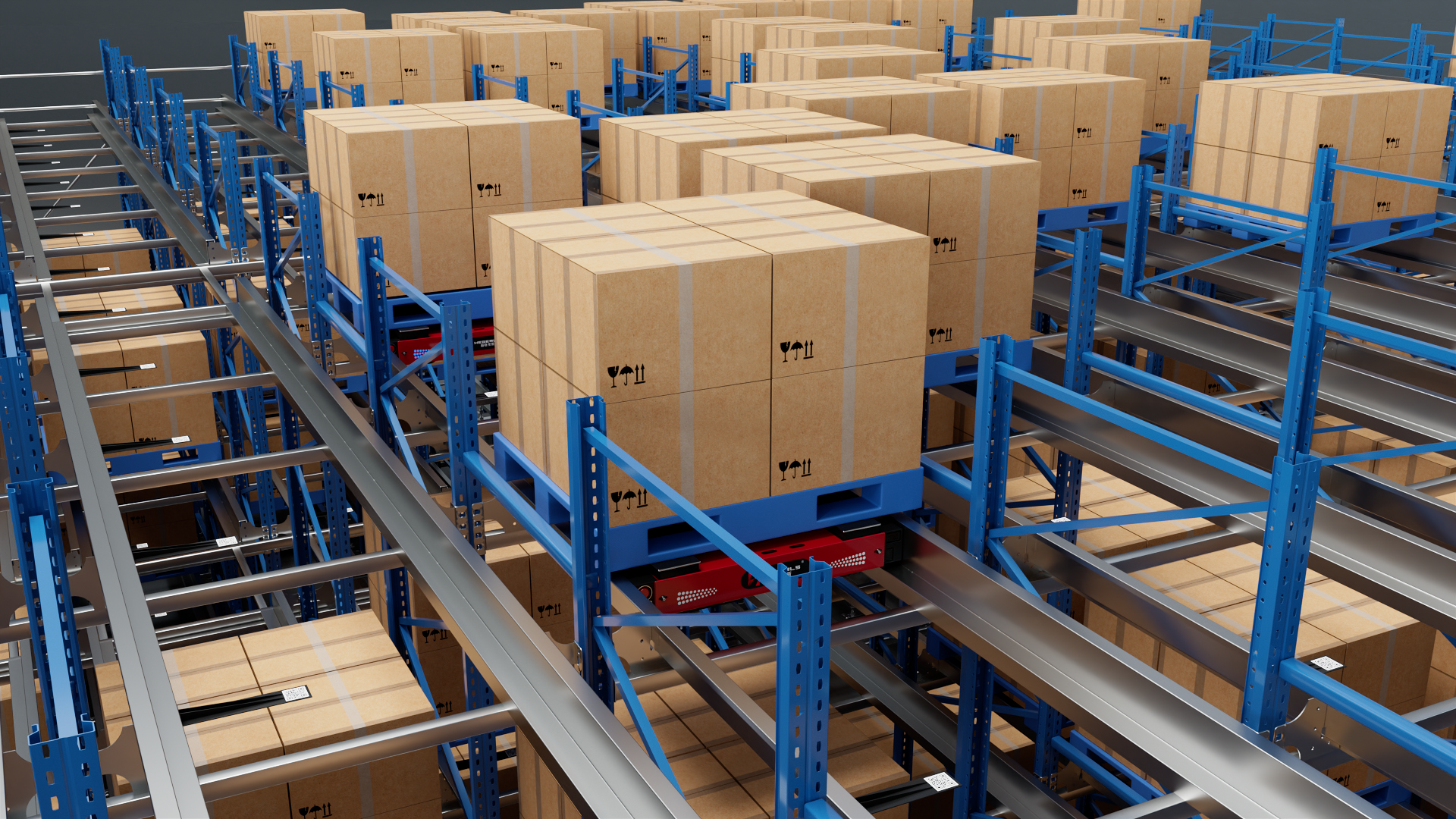
3. Four-Way Shuttle Systems
Four-way shuttle systems are among the most flexible modern automated storage technologies.
Unlike traditional shuttle systems, four-way shuttles can move:
- Forward
- Backward
- Left
- Right
This allows multi-directional movement inside dense racking systems.
HEGERLS Four-Way Shuttle Advantages
- Multi-vehicle collaboration
- High-density storage
- Flexible scalability
- Reduced aisle requirements
- Faster installation than crane ASRS
Technical Performance
4. Automated Bin Storage Systems
Automated bin storage systems store small parts inside bins or totes using robotic retrieval systems.
Ideal For
- Spare parts
- Electronics
- Medical products
- Small SKU operations
Benefits
- Fast picking
- Reduced errors
- Compact storage
- Improved inventory visibility
5. Vertical Lift Modules (VLM)
Vertical lift modules use vertical space to automatically retrieve trays or bins.
Benefits
- Saves floor space
- Ergonomic picking
- Ideal for spare parts
- Excellent for low-ceiling warehouses
6. Carousel Storage Systems
Carousel systems rotate inventory to operators automatically.
Types
- Horizontal carousel
- Vertical carousel
Advantages
- Fast order picking
- Compact storage
- Reduced walking distance
Automated Storage vs Traditional Warehousing
Comparison Table
| Feature | Traditional Warehouse | Automated Storage System |
|---|---|---|
| Storage Density | Low | Very High |
| Labor Dependency | High | Low |
| Picking Accuracy | 90–95% | >99% |
| Throughput | Moderate | High |
| Inventory Visibility | Limited | Real-time |
| Energy Efficiency | Lower | Higher |
| Scalability | Limited | Flexible |
Key Technologies Behind Automated Storage Systems
Modern automated warehouse storage systems combine hardware and software technologies.
Warehouse Management Systems (WMS)
WMS software manages:
- Inventory locations
- Picking tasks
- Order fulfillment
- Real-time tracking
HEGERLS CC-WMS supports seamless integration with:
- ERP
- MES
- WCS
- Robotics systems
Warehouse Control Systems (WCS)
WCS coordinates real-time equipment operations such as:
- Conveyors
- Shuttles
- ASRS cranes
- Sortation systems

Robotics and AI
AI-powered automation improves:
- Route optimization
- Inventory prediction
- Picking efficiency
- Energy optimization
IoT and Sensors
IoT devices monitor:
- Equipment status
- Inventory movement
- Temperature
- Energy consumption
Benefits of Automated Storage Systems
1. Higher Storage Density
Automated storage systems maximize vertical warehouse space.
Results
- 150–300% higher storage density
- Reduced warehouse footprint
- Lower rental costs
2. Improved Inventory Accuracy
Automation eliminates many human errors.
Accuracy Levels
Modern ASRS warehouses achieve:
99% inventory accuracy
3. Faster Throughput
Automated retrieval systems reduce travel time and optimize picking routes.
Typical Improvements
| Operation | Improvement |
|---|---|
| Picking Speed | +200% |
| Order Fulfillment | +150% |
| Inventory Counting | +80% |
4. Lower Labor Costs
Automation reduces manual labor requirements.
Benefits
- Lower staffing needs
- Reduced forklift operators
- Improved workplace safety
HEGERLS systems can reduce labor dependency by up to 70%.
5. Better Energy Efficiency
Modern automated warehouse storage systems use:
- Smart routing
- LED lighting
- Energy-efficient motors
- Predictive scheduling
This reduces overall energy consumption.
Applications of Automated Storage Systems
E-Commerce Warehouses
Challenges:
- High SKU count
- Rapid order fulfillment
- Seasonal peaks
Best Solutions:
- Mini-load ASRS
- Four-way shuttle systems
- Robotic picking
Manufacturing Warehouses
Challenges:
- Heavy pallets
- Spare parts management
- Production synchronization
Best Solutions:
- Unit load ASRS
- Automated bin storage
- Integrated WMS/MES

Cold Storage Warehouses
Challenges:
- Energy consumption
- Labor safety
- High-density requirements
Best Solutions:
- Crane ASRS
- Four-way shuttles
- Automated retrieval systems
HEGERLS cold storage ASRS systems significantly reduce labor exposure inside freezing environments.
How to Choose the Right Automated Storage System
1. Analyze SKU Characteristics
Consider:
- SKU quantity
- Weight
- Dimensions
- Turnover rate
2. Evaluate Throughput Requirements
Questions:
- Orders per day?
- Peak season volume?
- Picking frequency?
3. Consider Warehouse Height
Higher warehouses benefit more from:
- ASRS cranes
- Shuttle systems
- Vertical automation
4. Software Integration Requirements
Ensure compatibility with:
- ERP
- MES
- WMS
- Robotics
HEGERLS CC-WMS supports full warehouse integration.
5. Scalability
Choose modular systems that allow future expansion.
Four-way shuttle systems are highly scalable compared to fixed crane systems.
Future Trends in Automated Storage Systems
1. AI-Driven Warehousing
Artificial intelligence is becoming one of the most important technologies in warehouse automation.
AI-powered warehouse systems can analyze:
- Inventory movement patterns
- Order frequency
- Seasonal demand fluctuations
- Equipment performance
- Labor efficiency
- Energy consumption
This enables automated storage systems to continuously optimize warehouse operations.
Key Applications of AI in ASRS Warehouses
- Dynamic Slotting: AI automatically relocates fast-moving SKUs closer to picking stations to reduce retrieval time.
- Predictive Maintenance: Sensors and AI detect equipment wear before breakdowns occur, reducing downtime.
- Intelligent Task Scheduling: AI assigns tasks to shuttles, cranes, robots, and conveyors based on workload and traffic conditions.
- Demand Forecasting: Machine learning predicts inventory demand to improve storage allocation and replenishment planning.
2. Integration of Robotics and Automated Picking
Automated storage systems are increasingly integrating with robotic picking technologies.
Future warehouses will combine:
- ASRS systems
- Robotic arms
- Vision picking
- Autonomous mobile robots (AMRs)
- Automated picking and placing systems
This creates a fully connected automated fulfillment workflow.
Robotic Picking Trends
- AI Vision Recognition: Robots identify products using machine vision and deep learning.
- Multi-SKU Picking: Advanced robotic grippers can handle different product sizes and shapes.
- Collaborative Robots (Cobots): Cobots safely work alongside human operators.
- Automated Pick-and-Pack: Robots complete picking, sorting, and packing automatically.
3. Low-Carbon and Energy-Efficient Warehousing
Sustainability is becoming a major priority for global logistics operations.
Future automated warehouse storage systems will focus heavily on:
- Energy reduction
- Carbon neutrality
- Sustainable operations
Major Green Warehouse Trends
- Energy-Efficient Motors: New-generation motors reduce electricity consumption significantly.
- Regenerative Braking: ASRS cranes and shuttles recover energy during braking operations.
- Smart Lighting Systems: LED lighting with motion sensors minimizes power usage.
- Intelligent HVAC Management: AI controls warehouse temperature based on operational activity.
- Renewable Energy Integration: Warehouses increasingly integrate solar panels, battery storage systems and smart grid technologies.
4. Digital Twin Technology
Digital twin technology is becoming one of the most important innovations in warehouse automation.
A digital twin creates a real-time virtual model of the warehouse.
This allows operators to simulate:
- Inventory flow
- Shuttle movement
- Picking operations
- Congestion points
- Energy consumption
Benefits of Digital Twins
- Real-Time Optimization: Operators can identify inefficiencies instantly.
- Warehouse Simulation: Companies can test layout changes before implementation.
- Predictive Analysis: AI predicts operational bottlenecks before they occur.
- Faster Decision-Making: Managers gain complete visibility into warehouse operations.
Digital twin systems are expected to become standard in large-scale ASRS warehouse environments.
5. Cloud-Based Warehouse Automation
Cloud technology is transforming warehouse software architecture.
Future warehouse automation platforms will increasingly use:
- Cloud WMS
- Cloud WCS
- Remote monitoring
- SaaS warehouse management systems
Advantages of Cloud-Based Automation
- Lower IT infrastructure costs
- Easier software updates
- Multi-site warehouse management
- Real-time global visibility
- Faster deployment
HEGERLS CC-WMS supports intelligent integration and scalable warehouse management across multiple facilities.
6. Micro-Fulfillment Centers (MFCs)
The growth of e-commerce is driving demand for smaller urban fulfillment centers.
Micro-fulfillment centers use compact automated storage systems to support:
- Same-day delivery
- Rapid order fulfillment
- Urban logistics operations
Typical Technologies
- Mini-load ASRS
- Shuttle systems
- Robotic picking
- Automated shelving systems
This trend is especially strong in:
- Grocery fulfillment
- Retail e-commerce
- Pharmaceutical distribution
7. Human-Robot Collaboration
Future warehouses will not eliminate humans completely. Instead, they will optimize collaboration between people and automation.
Human Roles in Future Warehouses
- System supervision
- Exception handling
- Maintenance
- Quality control
- AI decision management
Automation Goals
The goal is not simply labor replacement, but:
- Safer operations
- Higher productivity
- Reduced physical strain
- Better workforce efficiency
Collaborative automation environments are becoming the dominant trend in modern warehouse design.

Why Choose HEGERLS Automated Storage Solutions
HEGERLS provides comprehensive automated warehouse storage systems including:
- Four-way shuttle systems
- ASRS warehouses
- Integrated racking systems
- Automated bin storage systems
- CC-WMS warehouse software
HEGERLS Advantages
| Advantage | Benefit |
|---|---|
| High-Density Storage | Save warehouse space |
| Intelligent CC-WMS | Real-time monitoring |
| Multi-Shuttle Collaboration | Higher throughput |
| Modular Design | Flexible expansion |
| Integrated Automation | End-to-end efficiency |
FAQ: Automated Storage Systems
1. What is ASRS in warehousing?
ASRS stands for Automated Storage and Retrieval System. It automates inventory storage and retrieval using robotics, shuttles, cranes, and software. HEGERLS ASRS systems improve storage density and warehouse efficiency significantly.
2. What are the types of ASRS systems?
Main types include:
- Unit load ASRS
- Mini-load ASRS
- Shuttle systems
- Automated bin storage systems
- Vertical lift modules
HEGERLS provides customized ASRS solutions based on industry requirements.
3. What are the benefits of automated storage systems?
Benefits include:
- Higher storage density
- Faster picking
- Lower labor costs
- Better inventory accuracy
- Improved energy efficiency
HEGERLS automated storage solutions can increase storage density by up to 300%.
4. How much does an ASRS warehouse cost?
Costs depend on:
- Warehouse size
- Automation level
- Throughput requirements
- Storage type
HEGERLS offers scalable automated warehouse storage systems for different budget levels.
5. What industries use automated storage systems?
Industries include:
- E-commerce
- Manufacturing
- Automotive
- Pharmaceutical
- Food & beverage
- Cold storage
HEGERLS supports multiple industries worldwide with customized warehouse automation solutions.
Upgrade Your Warehouse with HEGERLS Automated Storage Solutions
Looking to improve warehouse efficiency, storage density, and order fulfillment speed?
HEGERLS provides advanced:
- Automated storage systems
- ASRS warehouse solutions
- Four-way shuttle systems
- Automated retrieval systems
- Intelligent warehouse software
Benefits
- Increase storage density by up to 300%
- Reduce labor costs by up to 70%
- Achieve >99% inventory accuracy
- Improve warehouse throughput dramatically
Contact HEGERLS today for a customized automated storage solution.
Key words:
asrs automated storage retrieval system,asrs systems,automated storage,automated storage and retrieval system,automated storage systems
Related Solutions
Related Cases

Integrated Warehouse Rack Project in Morocco | Rack Supported Warehouse
Algeria FACTO Group Storage Project
Related Products

MOBILE: +86 133 1595 3337
E-mails: hgls-wm@hbgysw.com
Office: Room 1118, Building No.6, Tatan Mall, Tatong Street, Shijiazhuang, China
Production base: 68 Shidai Road,Xinhe Industrial Park,Hebei Province
Website: https://www.woke-hercules.com



All rights reserved©2025 Hebei Woke Metal Products Co., ltd.