

-
SOLUTIONSIn recent years, “Hegerls" HD shuttle storage system have improved, upgraded, more intelligent, flexible, and more systematic, which can meet the different needs of customers in various industries.
 SERVICE
 -
-
R & DObtained more than ten national patents for automated logistics warehousing equipment such as shuttle cars, stackers, and mobile shelves, awarded SGS, BV, and TUV international product quality inspection agency certificates, as well as the "Quality, Environment, Health" ISO three major system certification certificates.
SERVICE
-
PROJECTSAfter Haigelis entered the international market in 2011, it exported supermarket equipment, warehousing equipment, and related supporting products to countries and regions such as North America, South America, Europe, Southeast Asia, and Africa. In recent years, the company has increased its efforts in the research and development of automated warehousing equipment.
SERVICE
-
BlogProfessional articles, guides, and insights on warehouse racking and automated storage systems.
SERVICE
-
HEGERLSIt's developed over 20 years, our company has become a one-stop integrated service provider of warehousing and logistics, integrating warehousing and logistics project design...
SERVICE

APPLICATION
The Ultimate Guide to Warehouse Management Systems (WMS) in 2025
Classification:
Industry Info
Release time:
2025-09-09
In today’s fast-paced supply chain environment, many businesses still rely on manual spreadsheets, outdated software, or fragmented tools to manage inventory, track orders, and coordinate workflows. Now, it’s time to explore the power of a Warehouse Management System (WMS) — the digital backbone of modern warehouse operations.
This guide will break down what WMS is, why it’s essential for businesses of all sizes, key features to look for, and how to implement it successfully. By the end, you’ll understand how a WMS can bring order to chaos and fuel long-term business growth.
What is a Warehouse Management System (WMS)?
A Warehouse Management System (WMS) is specialized warehouse management software designed to control and optimize every aspect of warehouse operations. By integrating mobile devices with barcode scanning, RFID technology, and other tracking tools, a WMS creates a reliable digital foundation for warehouse transactions. This ensures real-time data synchronization, reduces human errors, and provides accurate task instructions—such as optimizing picking routes or assigning storage locations—to improve operational efficiency.
At its core, a WMS manages the full warehouse lifecycle: receiving and inspection, put-away, inventory storage, cycle counting, picking, packing, and shipping. Beyond these standard functions, modern WMS solutions also include advanced modules for labor management, performance tracking, and inventory optimization.
For businesses looking to improve accuracy, reduce costs, and streamline supply chain operations, a Warehouse Management System is the foundation of warehouse automation and smarter logistics.
Advantages of WMS: Why Business Should Invest in HEGERLS WMS Solutions
1. Real-Time Warehouse Visualization
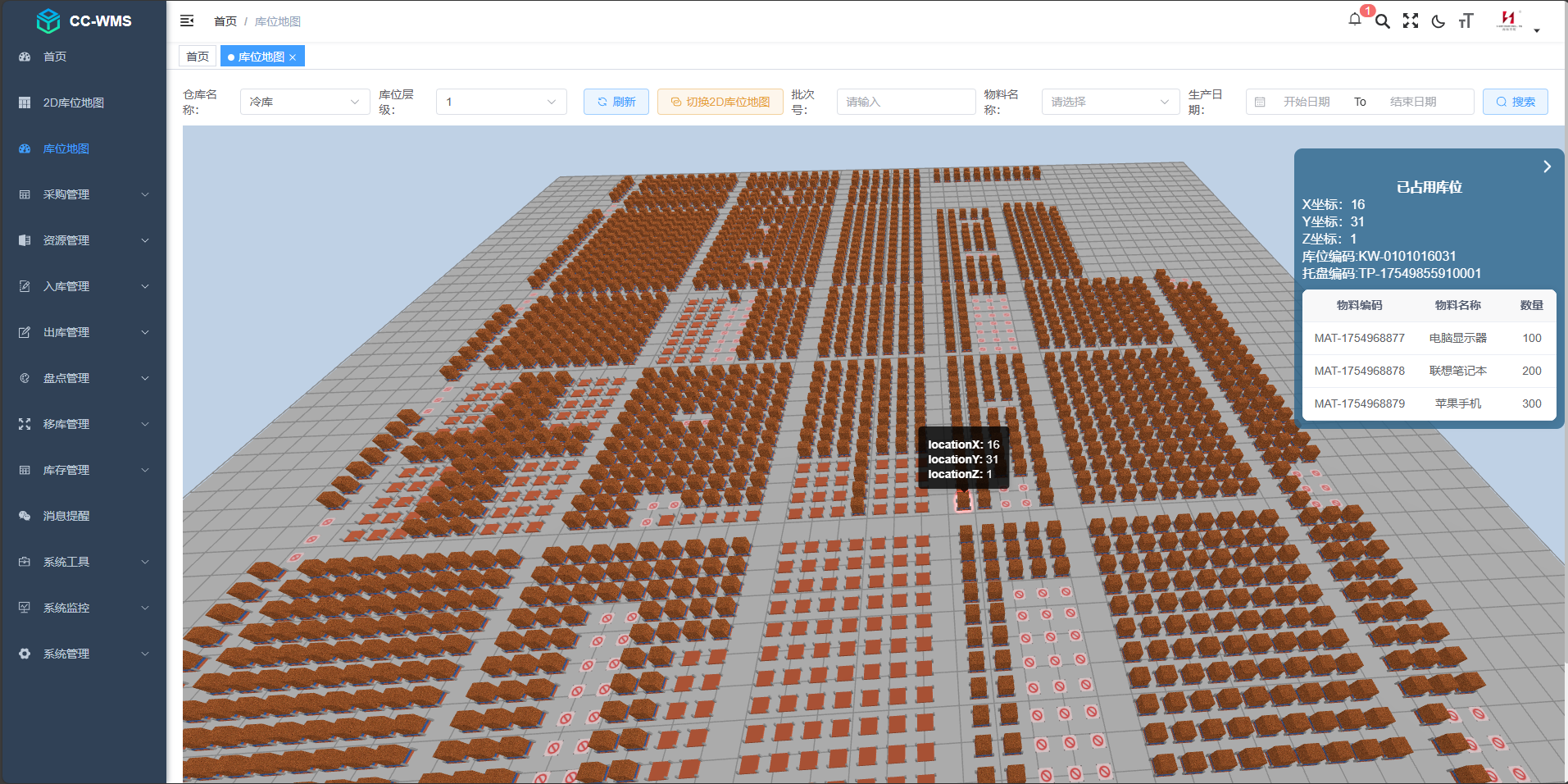
With 2D and 3D warehouse mapping, managers can see every storage location at a glance. Simply hover over a slot to view detailed inventory information or use search filters to instantly locate and highlight goods. This improves visibility, reduces search time, and prevents misplaced items.
2. Smarter Inbound Operations
Forget complex paperwork—WMS enables one-click inbound order creation. A single pallet can store multiple SKUs with detailed tracking for each, while intelligent allocation rules automatically assign optimal storage locations. The result? Faster inbound processing and maximized warehouse space utilization.
3. Intelligent Outbound Management
Traditional outbound workflows are time-consuming and error-prone. With WMS, you can select items directly on a 2D map for one-click outbound, reducing order creation time by up to 70% and cutting errors to less than 1%. Advanced features like PDA-based picking and expiry-date FIFO rules ensure accuracy and compliance for sensitive goods such as food or pharmaceuticals.
4. Continuous Storage Optimization
A WMS doesn’t just store goods—it optimizes your warehouse layout. Through automated “smart reorganization,” the system continuously suggests adjustments based on SKU velocity and storage rules. This ensures that high-turnover items are always in the right place for maximum picking efficiency.
5. Accurate and Flexible Inventory Control
Cycle counting is simplified with intelligent and selective inventory checks, while real-time stock alerts prevent costly stockouts or overstocking. The system also tracks expiry dates, ensuring perishable goods are handled properly and reducing inventory losses.
6. Secure User and Role Management
Not every team member should have the same level of access. WMS allows granular role-based permissions, ensuring that data, operations, and system features are accessible only to authorized personnel. This improves security while maintaining operational transparency.
Key Features of a Warehouse Management System (WMS)
| Feature | What It Does | Why It Matters |
|---|---|---|
| Inventory Tracking | Monitors stock levels, locations, lot/serial numbers, and expiration dates. | Ensures real-time accuracy, reduces shrinkage, and supports compliance. |
| Order Management | Automates order processing from receiving to pick/pack/ship. | Speeds up order fulfillment, reduces manual errors, and improves customer satisfaction. |
| Labor Management | Tracks worker performance, allocates tasks, and creates productivity reports. | Optimizes staffing, increases efficiency, and lowers labor costs. |
| Space Utilization | Analyzes layout and assigns fast-moving items to prime storage zones. | Maximizes warehouse space, reduces costs, and improves operational flow. |
| Reporting & Analytics | Provides insights on metrics like inventory turnover, fulfillment speed, error rates. | Enables data-driven decision-making and continuous process improvement. |
| Integration Capabilities | Connects with ERP (SAP, Oracle), e-commerce (Shopify), and shipping carriers. | Breaks down data silos, streamlines workflows, and improves end-to-end visibility. |
| Mobile Access | Enables scanning, inventory updates, and task viewing on smartphones/tablets. | Increases flexibility, supports real-time updates, and reduces reliance on desktops. |
What are the Main Types of Warehouse Management Systems?
When people talk about the types of Warehouse Management Systems (WMS), they usually mean the deployment models that companies can choose based on size, budget, and technical needs. The four main types are:
Standalone WMS → Focused, low-cost option.
Supply Chain Execution (SCE) Modules → Broader supply chain integration.
ERP-Integrated WMS → Enterprise-wide system alignment.
Cloud-Based WMS → Scalable, flexible, and cost-efficient.
Here’s a comparison table for the four types of Warehouse Management Systems
| Type of WMS | Key Features | Pros | Cons | Best For |
|---|---|---|---|---|
| Standalone WMS | Dedicated software focusing on core warehouse functions like inventory tracking, picking, receiving, and shipping. | Lower upfront cost, simple to use, focused on warehouse tasks. | Limited integration with other business systems; less visibility across supply chain. | Small to mid-sized businesses that only need warehouse-specific functions. |
| Supply Chain Execution (SCE) Module | Part of a broader supply chain suite including transportation, order management, and logistics. | End-to-end supply chain visibility, better coordination between warehouse and logistics. | Higher cost; may be complex to implement. | Companies that need to manage both warehouse operations and wider supply chain processes. |
| ERP-Integrated WMS | A module within an Enterprise Resource Planning (ERP) system; connects warehouse with finance, procurement, and customer service. | Unified database, enterprise-wide integration, strong reporting and analytics. | More expensive; implementation can be lengthy and complex. | Medium to large enterprises seeking centralized control and cross-departmental efficiency. |
| Cloud-Based WMS | Delivered as SaaS; accessible from anywhere with internet; real-time updates and mobile support. | Scalable, flexible, quick implementation, lower IT infrastructure cost. | Requires stable internet connection; ongoing subscription costs. | Businesses of all sizes that value flexibility, real-time data access, and minimal IT management. |
Top 10 Warehouse Management Systems in 2025
Choosing the right WMS is crucial to unlocking efficiency. Here are 10 leading WMS solutions in 2025, catering to different business sizes and industries:
Cloud Command WMS Warehouse Management System (CC-WMS): Combines traditional warehouse management functions with AI-driven analytics and storage optimization, reducing workload by over 30% and achieving up to 99.9% data accuracy. HEGERLS CC-WMS system offers 3D visualization of storage locations, intelligent algorithms for FIFO and zone-based strategies, and seamless OpenAPI integration with ERP, e-commerce, and logistics systems. With multi-language support in 16 languages, CC-WMS is built for scalable, global warehouse operations.

SAP Extended Warehouse Management (SAP EWM): Best for global enterprises needing advanced inventory optimization and ERP integration.
Manhattan Associates Supply Chain Commerce: Strong in omnichannel fulfillment with AI-driven demand forecasting.
Blue Yonder WMS (formerly JDA): Cloud-native, machine learning–powered, with fast deployment.
Fishbowl Inventory: Affordable, QuickBooks and Shopify integration, ideal for SMBs.
Oracle Warehouse Management Cloud (OWMC): Cloud-first with IoT integration, suited for regulated industries.
HighJump WMS (Körber Supply Chain): Modular, robotics-ready, strong in cold chain and automotive.
DEAR Systems: Lightweight cloud WMS for small e-commerce and boutique retailers.
Tecsys WMS: Strong in healthcare and high-urgency supply chains.
SAP Business One WMS: Streamlined WMS for SMBs already using SAP B1 ERP.
How to Implement a WMS Successfully
Implementing a Warehouse Management System (WMS) is a major project—but with the right strategy, it can be smooth, efficient, and highly rewarding. Follow these five steps to ensure success:
1. Define Your Goals & Requirements
Start by identifying the problems you want to solve. For example:
✅“Reduce shipping errors by 50%.”
✅“Cut inventory holding costs by 20%.”
✅“Comply with FDA tracking requirements for medical supplies.”
List your must-have features (e.g., lot and batch tracking) and nice-to-have features (e.g., AI-powered demand forecasting). This clarity will help you evaluate and compare WMS vendors effectively.
2. Choose the Right Vendor
Your WMS vendor should offer:
✅Industry expertise (e.g., food distribution vs. electronics).
✅Strong customer support (24/7 help desk, training resources).
✅Scalability (supporting growth with new warehouses and integrations).
Check reviews, request demos, and involve your warehouse team in the decision-making process to ensure practical usability.
3. Plan for Data Migration
Migrating from spreadsheets or an old system requires careful preparation:
✅Clean your data (remove duplicates, fix errors).
✅Test migration with a small dataset before full transfer.
✅Collaborate with your vendor for a seamless transition.
This step ensures your WMS starts on a strong foundation.
4. Train Your Team
A WMS only delivers value when your team knows how to use it. Provide:
✅Hands-on training (using scanners, dashboards, and reporting tools).
✅Role-based training (pickers, managers, and admins).
✅Ongoing support (help desk or in-house trainer).
5. Monitor & Optimize
After go-live, measure success with key metrics:
✅Order accuracy rates
✅Fulfillment times
✅Inventory accuracy
Leverage the WMS’s analytics tools to optimize processes. Remember—WMS implementation is continuous. As your business grows (new products, new markets), refine workflows to maintain peak efficiency.
The Future of WMS: What’s Next?
The Warehouse Management System (WMS) landscape is changing rapidly, fueled by innovations in AI, IoT, robotics, and cloud technology. Businesses that embrace these trends will gain a competitive edge in efficiency, accuracy, and scalability. Here’s what to expect in 2025 and beyond:
AI-Powered Forecasting
Future WMS platforms will leverage artificial intelligence to:
✅Predict demand with greater accuracy.
✅Optimize inventory levels in real time.
✅Recommend workflow improvements (e.g., “Moving Item Z to Zone A will cut pick time by 15%”).
This shift means fewer stockouts, smarter labor planning, and faster fulfillment.
IoT Integration
IoT (Internet of Things) devices will connect directly to WMS, enabling real-time visibility across the supply chain:
✅Temperature sensors for perishable goods.
✅GPS trackers for in-transit shipments.
✅RFID and smart tags for instant inventory updates.
This data-driven approach improves transparency and reduces losses.
Robotics Collaboration
Next-generation WMS will seamlessly coordinate with warehouse robots:
✅Autonomous mobile robots (AMRs) to transport goods.
✅Pick-and-place robots to handle repetitive tasks.
By automating routine operations, WMS frees human workers to focus on higher-value activities like problem-solving and quality control.
Cloud-Based WMS
More businesses will move away from on-premise solutions to adopt cloud-based WMS because of:
✅Lower upfront costs.
✅Easy scalability across multiple warehouses.
✅Remote accessibility for managers and teams worldwide.
Cloud deployment also ensures faster updates, stronger security, and better integration with other business tools.
Conclusion
A Warehouse Management System (WMS) is more than a tool — it’s a strategic investment in your business future. By reducing errors, improving efficiency, and delivering real-time visibility, WMS transforms warehouses from cost centers into growth engines.
Whether you’re a small startup or a large enterprise, the right WMS can help you achieve smoother operations, happier customers, and higher profitability.
Ready to take the next step or have questions about choosing a WMS? Get a free quote or reach out to our team for a free consultation!
Key words:
Related Cases

undefined
Related Products

MOBILE: +86 133 1595 3337
E-mails: hgls-wm@hbgysw.com
Office: Room 1118, Building No.6, Tatan Mall, Tatong Street, Shijiazhuang, China
Production base: 68 Shidai Road,Xinhe Industrial Park,Hebei Province
Website: https://www.woke-hercules.com



All rights reserved©2025 Hebei Woke Metal Products Co., ltd.