Two-way shuttle
Moves forward and backward along a lane.




APPLICATION
Classification:
Enterprise News
Release time:
2025-08-27
Today we focus on introducing the HEGERLS pallet (tray) shuttle system for dense storage. From two-way to six-way shuttles, learn how it significantly boosts storage density and operational efficiency compared with traditional solutions.

A pallet shuttle system is an intensive storage solution that automates pallet movements within racking lanes. It achieves far higher storage density than older technologies such as double-depth stackers and conventional AS/RS, and is especially effective in cold storage where space is costly.
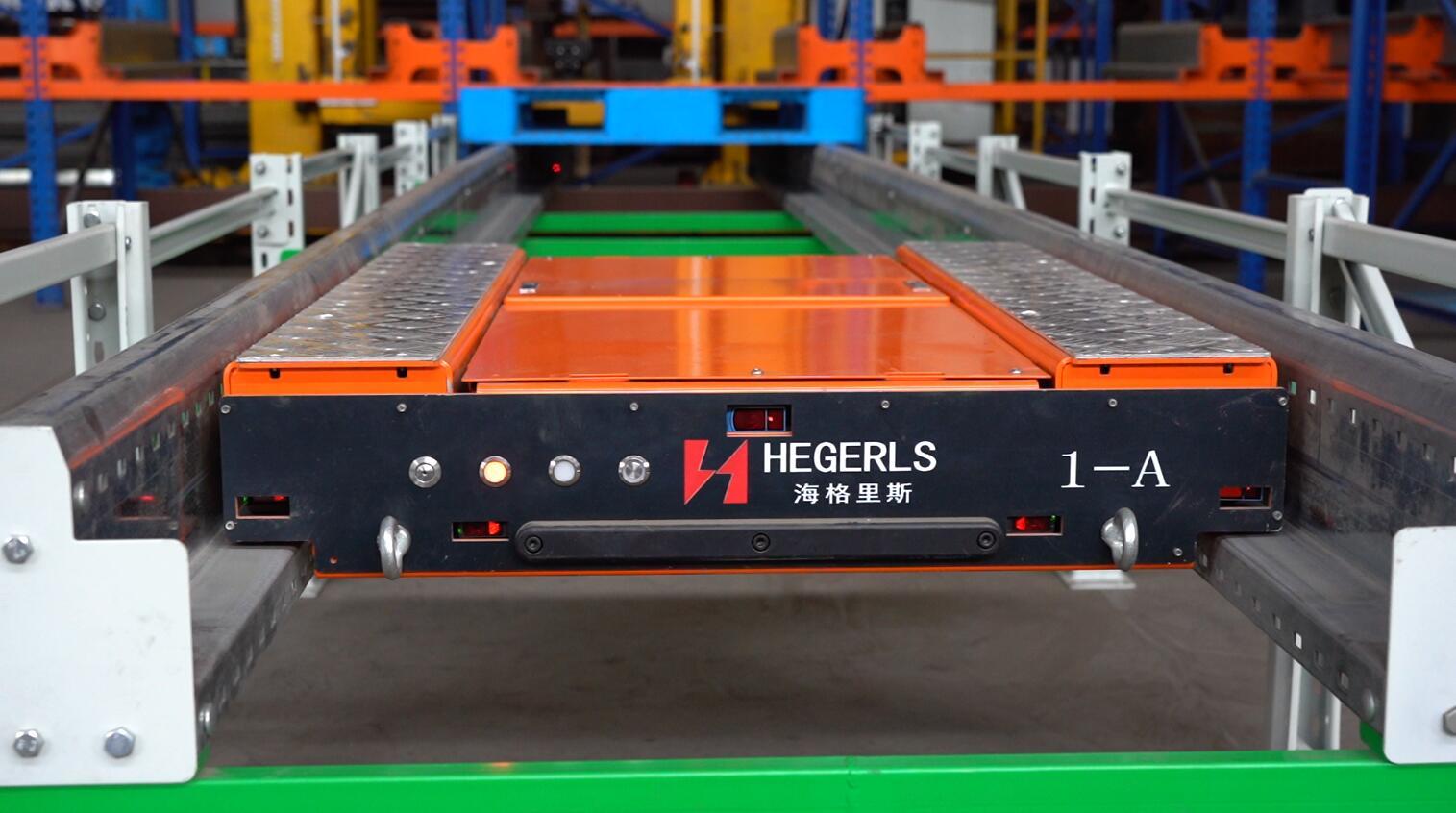
Two-way shuttle
Moves forward and backward along a lane.
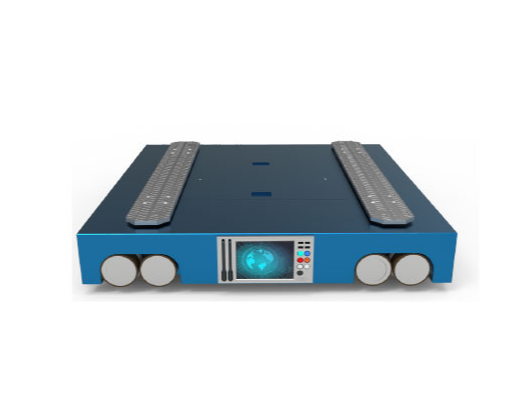
Four-way shuttle
Moves forward/backward and left/right, enabling lane changes and flexible routing.
Six-way shuttle
Multi-directional capability in X/Y/Z for complex 3D dense storage.

Other shuttle forms exist but are less common in access applications; this article focuses on shuttles used for high-density pallet storage.
Parameter / Type | Two-Way Shuttle | Four-Way Shuttle | Six-Way Shuttle |
Movement Direction | Forward & backward | Forward/backward + left/right | Multi-directional (X/Y/Z) |
Flexibility | Lane-constrained | Can switch lanes; layout-adaptive | Highest; supports complex 3D grids |
Storage Density | Medium | High (often +30%~50% vs traditional) | Very high; maximizes irregular spaces |
Typical Application | Straight channels, medium turnover | General warehouses; FMCG; tobacco | Cold chain; high-value goods; complex layouts |
System Cost | Low | Medium | Higher |
Scalability | Upgradeable to mother-child | Easy multi-level expansion | Best for fully automated 3D systems |
Spec | Two-Way Shuttle | Four-Way Shuttle | Six-Way Shuttle |
Payload (kg) | 1,500 | 1,000–2,000 | 1,000–2,000 |
Compatible Pallet Size (mm) | 1,000×1,200 / 1,100×1,100 / 1,100×1,200, etc. | 1,000×1,200 / 1,100×1,100 / 1,100×1,200, etc. | 1,000×1,200 / 1,100×1,100 / 1,100×1,200, etc. |
Travel Speed (loaded) | 0.7 m/s | 1.2 m/s | 1.2 m/s |
Lateral Switch / Lane Change | Not supported | Supported | Supported (multi-axis) |
Positioning Accuracy | ±2 mm | ±2 mm | ±2 mm |
Operating Temperature | -40℃ to +60℃ (option) | -40℃ to +60℃ (option) | -40℃ to +60℃ (option) |
Battery Type / Endurance | Lithium Iron Phosphate / ≥8 h typical | lithium iron phosphate / ≥8 h typical | lithium iron phosphate / ≥8 h typical |
Charging Time | 3.5 h | ≤1.5 h | ≤1.5 h |
Lift Stroke | 40 mm | 40 mm | 40 mm |
Lift time | 1.5 s | 1.5 s | 1.5 s |
Control Modes | Remote / HMI / WCS | Remote / HMI / WCS | Remote / HMI / WCS |
Safety Features | Obstacle detection, anti-drop, E‑stop | Obstacle detection, anti-drop, E‑stop | Obstacle detection, anti-drop, E‑stop |
- Conveyors (roller/chain) and vertical lifts for inbound pallets.
- Optional robotic depalletizing for automated infeed.
- Shuttle racking, shuttles, level-changing lifts or stacker cranes.
- Mother–child architecture available for multi-level throughput.
- WMS/WCS orchestration, task scheduling, traffic management.
- Supports FIFO & LIFO strategies, barcode/RFID integration.
- Conveyors and ergonomic picking stations.
- Automated palletizing for shipping preparation.

The pallet shuttle system has become a game-changer in warehouse automation and dense storage solutions. Compared with traditional racking and AS/RS systems, it offers multiple advantages:
- Increases warehouse capacity by 30%–50% compared to traditional AS/RS or drive-in racks.
- Ideal for maximizing expensive warehouse or cold storage space.
- Four-way and six-way shuttles can operate in irregular layouts, making full use of every cubic meter.
- Not limited by warehouse shape, unlike stacker crane systems.
- Automated pallet handling reduces waiting time for forklifts.
- Supports FIFO (First In, First Out) and LIFO (Last In, First Out) inventory strategies.
- Faster pallet retrieval ensures smooth order fulfillment.
- Less reliance on forklift drivers inside dense aisles.
- Improves warehouse safety by reducing the risk of accidents in narrow or high-bay storage areas.
- Workers operate shuttles remotely or through automated dispatching systems.
- Particularly effective in cold storage warehouses, where maximizing storage density lowers cooling costs.
- Automated operation reduces human exposure to low-temperature environments, improving working conditions.
- Can start with a simple two-way shuttle solution and expand to mother-child or four-way systems as business grows.
- Easily integrates with WMS (Warehouse Management System) and WCS (Warehouse Control System) for smart scheduling and real-time inventory management.
- Widely applied in tobacco, food & beverage, industrial manufacturing, cold chain logistics, and other sectors.
- Adaptable for both high-turnover fast-moving goods and long-term bulk storage.
Dense storage systems powered by pallet shuttles are ideal for:
- Tobacco — raw materials and finished goods.
- Food & Beverage — high-volume SKUs with fast rotation.
- Industrial Manufacturing — semi-finished and finished goods buffers.
- Cold Chain Logistics — makes the most of expensive refrigerated space while improving working conditions.


Looking to upgrade warehouse capacity and efficiency? Our engineering team designs and delivers turnkey shuttle racking solutions tailored to your layout, SKU profile, and throughput targets. Contact us today to get your best warehouse solutions.
Key words:
Related Solutions
Related Cases

undefined
Related Products

MOBILE: +86 133 1595 3337
E-mails: hgls-wm@hbgysw.com
Office: Room 1118, Building No.6, Tatan Mall, Tatong Street, Shijiazhuang, China
Production base: 68 Shidai Road,Xinhe Industrial Park,Hebei Province
Website: https://www.woke-hercules.com

All rights reserved©2025 Hebei Woke Metal Products Co., ltd.


