

-
SOLUTIONSIn recent years, “Hegerls" HD shuttle storage system have improved, upgraded, more intelligent, flexible, and more systematic, which can meet the different needs of customers in various industries.
 SERVICE
-
-
R & DObtained more than ten national patents for automated logistics warehousing equipment such as shuttle cars, stackers, and mobile shelves, awarded SGS, BV, and TUV international product quality inspection agency certificates, as well as the "Quality, Environment, Health" ISO three major system certification certificates.
SERVICE
-
PROJECTSAfter Haigelis entered the international market in 2011, it exported supermarket equipment, warehousing equipment, and related supporting products to countries and regions such as North America, South America, Europe, Southeast Asia, and Africa. In recent years, the company has increased its efforts in the research and development of automated warehousing equipment.
SERVICE
-
BlogProfessional articles, guides, and insights on warehouse racking and automated storage systems.
SERVICE
-
HEGERLSIt's developed over 20 years, our company has become a one-stop integrated service provider of warehousing and logistics, integrating warehousing and logistics project design...
SERVICE

APPLICATION
Smart Warehouse System Architecture: From Planning to Automation Implementation
Classification:
Industry Info
Release time:
2026-01-05
1. Why Are More Companies “Redoing” Their Warehouse Systems?
In manufacturing, distribution, and 3PL industries, warehouses are no longer just places to store inventory.
With fragmented orders, exploding SKU counts, and compressed delivery cycles, traditional warehouses commonly face challenges such as:
- Low picking efficiency relying on manual labor
- Insufficient space utilization leading to high expansion costs
- Disjointed information systems and opaque inventory data
- Lack of scalability during peak periods and resource waste during low periods
Against this backdrop, smart warehouse systems (Smart Warehouse / AS/RS) have become critical for reducing cost, improving efficiency, and achieving flexible expansion. However, in many projects it’s clear that equipment procurement is not difficult — the real challenges lie in system-level planning and engineering execution.
2. What Makes a Complete Smart Warehouse System?
From an engineering perspective, a truly sustainable smart warehouse system has at least four layers:
- Warehouse Planning Layer (Planning)
- Physical Execution Layer (Equipment)
- Control and Dispatch Layer (WCS)
- Management and Decision Layer (WMS / ERP)
If we compare a smart warehouse to a “body with a brain”:
- Warehouse planning = structural design
- Automated equipment = muscles & joints
- WCS = nervous system
- WMS/ERP = brain
Any failure at one layer can amplify project cost later.

3. Step 1: Warehouse Planning Is the “Foundation Project”
In automation projects, 70% of problems originate in the planning phase.
Good planning doesn’t simply draw layouts; it answers key questions such as:
- What will be stored? (SKU types, sizes, weights, turnover)
- How much inventory? (peak volumes, growth for the next 3–5 years)
- How will goods move? (inbound, outbound, picking, replenishment paths)
- Who uses it? (manual, automated, or hybrid operations)
Common planning mistakes include:
- Designing only for current needs without future expansion
- Focusing on storage density while ignoring operational efficiency
- Choosing equipment before understanding warehouse structure
A reasonable planning process must precede equipment selection.
4. Step 2: What Does an Automated Equipment System Comprise?
1) Main Types of Automated Warehouse Equipment
| System Type | Typical Use |
|---|---|
| Stackers AS/RS | High-density pallet storage |
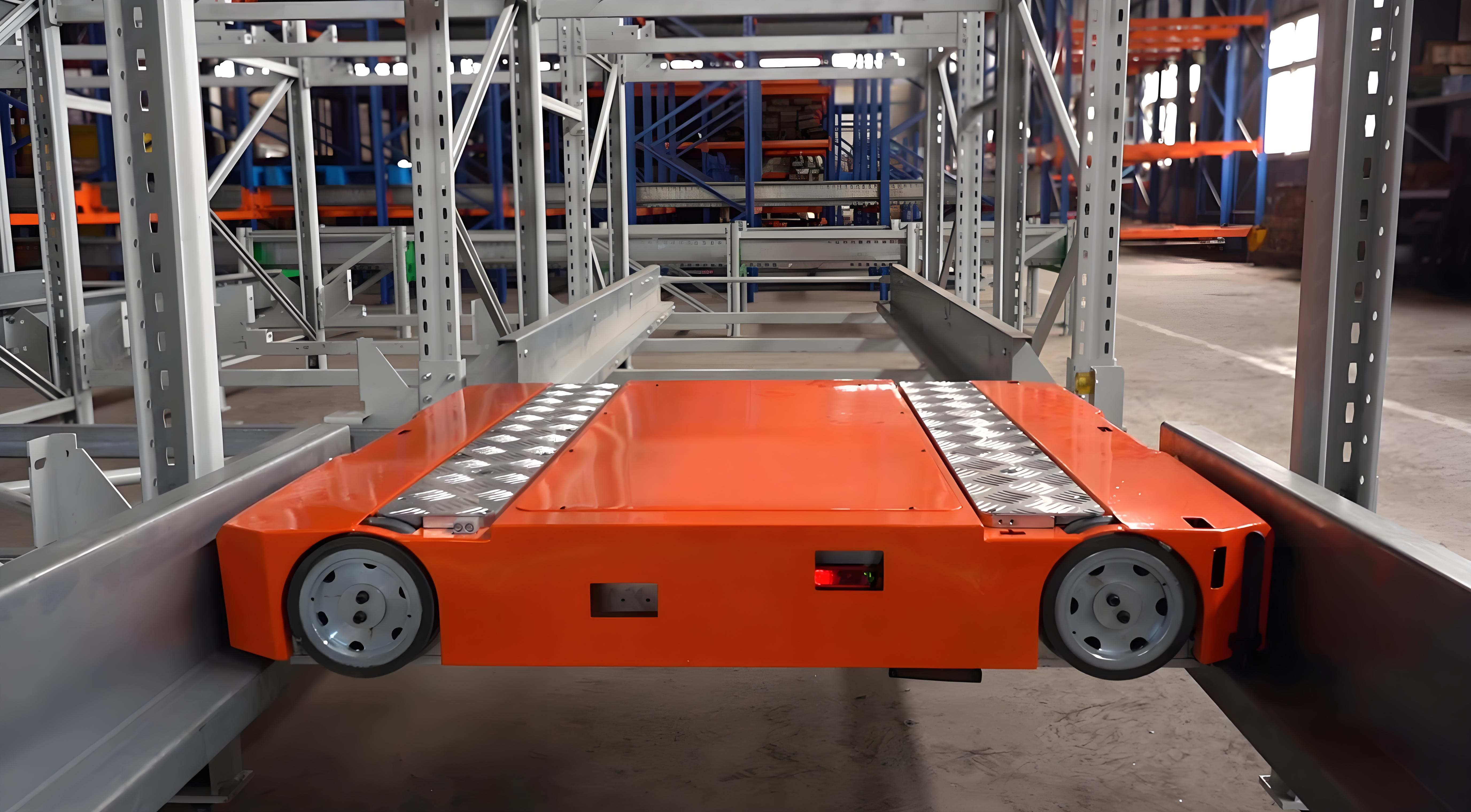
| Four-way Shuttle Systems | Medium/larger dense storage |
| Multi-shuttle Systems | High throughput carton storage |
| AMR / AGV | Flexible handling & line interface |
| Vertical Lift / Conveyors | Vertical & horizontal links |
In real projects, no single device solves all problems. Most use combinations of systems for optimal performance.
2) Advantages of Four-Way Shuttle Systems
In recent years, four-way shuttle systems have grown rapidly in mid to large warehouses because of:
- High storage density
- Modular scalability
- Low maintenance impact
- Support for multiple parallel aisles
Such systems demand higher precision in rack structure, scheduling algorithms, and integration ability.
5. Step 3: Integrated Rack & Building Structure Collaboration
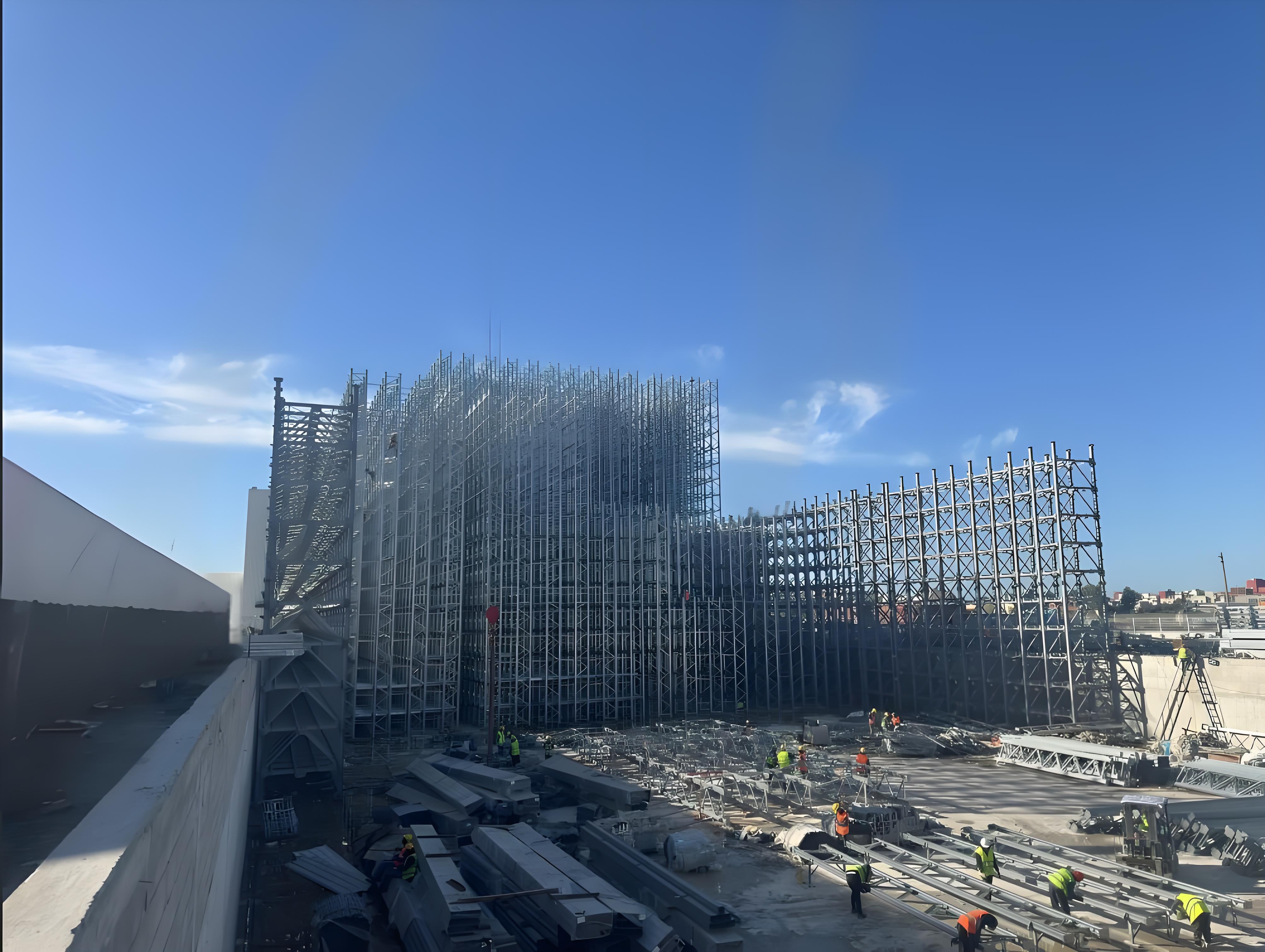
In large-scale projects, many enterprises adopt rack-supported warehouses where:
- Racks serve as the primary building load-bearing structure
- They require higher wind, snow, and seismic design standards
- Deep coupling with automation devices and fire systems is needed
Here, the core challenge is the system integration of structural engineering + automation + building code compliance — not just rack fabrication.
6. Step 4: Coordination Between WMS and WCS
1) Warehouse Management System (WMS)
- Primarily responsible for:
- Inventory logic
- Order management
Strategy rules (e.g., FIFO, wave planning)

2) Warehouse Control System (WCS)
Primarily responsible for:
- Equipment dispatch
- Path planning
- Real-time execution control

3) Key Points in Engineering Practice
- WMS decision logic should not overtake direct equipment control
- WCS must handle exceptions
- Interfaces are often more important than the system itself
Many project issues arise from unclear system boundaries rather than insufficient capabilities.
7. Typical Challenges in Smart Warehouse Implementation
Common difficulties include:
- Errors between actual SKU data and early estimates
- Inaccurate peak order forecasting models
- Poor collaboration between manual and automated operations
- Construction tolerances affecting equipment stability
These problems are rarely solved by purchasing “more expensive equipment” — instead, they require solid engineering methodology.
8. How Can You Evaluate a Smart Warehouse Solution?
You can judge from five dimensions:
- Support for future expansion
- Fault degradation capability
- Match with real operational processes
- Consideration of maintenance & O&M costs
- Clear system boundaries
A mature solution is not necessarily the most efficient — it’s one with controllable risk.
9. Smart Warehousing Is a Long-Term System Project
Smart warehouse construction typically goes through:
- Phase 1: Basic automation
- Phase 2: System optimization
- Phase 3: Data-driven & intelligent scheduling
Thus planning must avoid solutions designed only for the first phase.
10. Engineering Summary
From an engineering viewpoint, the success of a smart warehouse depends on:
- Solid early planning
- Clear system architecture
- Coordination between equipment and software
- Ability for long-term evolution
Automation is not the goal — stable, efficient, and scalable systems are.
About This Article
This summary is based on HEGERLS’s practical experience in smart warehousing and automated logistics projects. Contact HEGERLS for a customized solution.

FAQ
1. What is a smart warehouse system architecture?
A smart warehouse system architecture is a structured framework that defines how planning, automation equipment, control systems, and management software work together to operate a warehouse efficiently and intelligently.
2. What are the core layers of a smart warehouse system?
A typical smart warehouse architecture includes four key layers: planning (layout and strategy), execution (automation equipment), control (WCS), and management (WMS/ERP). Each layer plays a distinct role in ensuring smooth warehouse operations.
3. Why is system architecture more important than equipment selection?
Because even advanced equipment cannot perform well without proper system design. Poor architecture leads to inefficiencies, integration issues, and higher long-term costs, while a well-designed system ensures scalability and stability.
4. What is the role of WMS in a smart warehouse system?
The Warehouse Management System (WMS) is responsible for inventory control, order management, and operational strategies such as picking logic and stock allocation, acting as the decision-making layer of the system.
5. What does a Warehouse Control System (WCS) do?
The WCS acts as the execution layer that directly controls equipment, manages task scheduling, and ensures real-time coordination between different automated devices in the warehouse.
6. How does warehouse planning impact system performance?
Warehouse planning determines storage layout, workflow design, and capacity forecasting. Most system issues originate from poor planning, such as underestimating future growth or ignoring operational efficiency.
7. What types of automation equipment are used in smart warehouse systems?
Common equipment includes stacker cranes (AS/RS), four-way shuttle systems, multi-shuttle systems, AMRs/AGVs, and conveyor systems, often combined to meet different storage and throughput requirements.
8. How do WMS and WCS work together in a smart warehouse?
WMS handles high-level decision-making and task generation, while WCS translates those tasks into executable commands for equipment. Clear boundaries between the two systems are essential for stable operation.
9. What are the biggest challenges in smart warehouse implementation?
Common challenges include inaccurate demand forecasting, mismatched SKU data, poor integration between manual and automated processes, and construction or installation tolerances affecting system performance.
10. How can companies evaluate a smart warehouse system design?
A reliable system should be evaluated based on scalability, operational efficiency, fault tolerance, maintenance cost, and how well it matches real business processes rather than theoretical performance.
11. What makes a smart warehouse system truly scalable?
A scalable system is designed with modular architecture, allowing businesses to expand storage capacity, add automation equipment, and upgrade software without rebuilding the entire system.
12. Is smart warehouse architecture a one-time project or a long-term strategy?
It is a long-term system project that evolves in stages—from basic automation to system optimization and eventually to data-driven intelligent operations.
Key words:
smart warehouse system,warehouse automation,ASRS,four way shuttle system,rack supported warehouse
Related Solutions
Related Cases

Integrated Warehouse Rack Project in Morocco | Rack Supported Warehouse
Algeria FACTO Group Storage Project
Related Products

MOBILE: +86 133 1595 3337
E-mails: hgls-wm@hbgysw.com
Office: Room 1118, Building No.6, Tatan Mall, Tatong Street, Shijiazhuang, China
Production base: 68 Shidai Road,Xinhe Industrial Park,Hebei Province
Website: https://www.woke-hercules.com



All rights reserved©2025 Hebei Woke Metal Products Co., ltd.